Spots used to worry me more than whole yellow leaves. A yellow leaf at least feels easier to read. But once a leaf starts showing yellow speckles, brown spots, or yellow patches with darker centers, my mind goes straight to disease.
What I learned over time is that these patterns do not all point in the same direction. Some show up after heat stress. Some are tied to roots that have already been struggling. Some really do make me think about infection. And some look worse than they actually are when you first notice them.
That is why I no longer judge spotted leaves by color alone. I pay much more attention to the pattern: whether the marks are tiny or blotchy, whether they have yellow halos or dark centers, whether they stay contained or keep spreading, and what has been happening around the plant lately. In my experience, that usually tells the real story much faster than the color itself.
The Spot Patterns That Sent Me Looking in Completely Different Directions
One of the hardest things about yellow and brown spots on Anthurium leaves is that they can look vaguely similar at first while meaning very different things. A leaf covered in pale yellow speckles does not behave the same way as a leaf with brown-centered lesions, and neither of those looks quite like the darker blotches that made me start worrying about infection.
These are the spot patterns I have personally run into at home, and each one pushed me in a different direction.
Tiny Yellow Speckles After a Hot Stretch
One time, one of my Anthurium leaves suddenly developed lots of tiny yellow speckles, so many that the whole leaf started looking dusted with yellow. My first reaction was panic. I thought the plant must have caught some kind of disease, because the spotting looked too widespread and strange to dismiss.
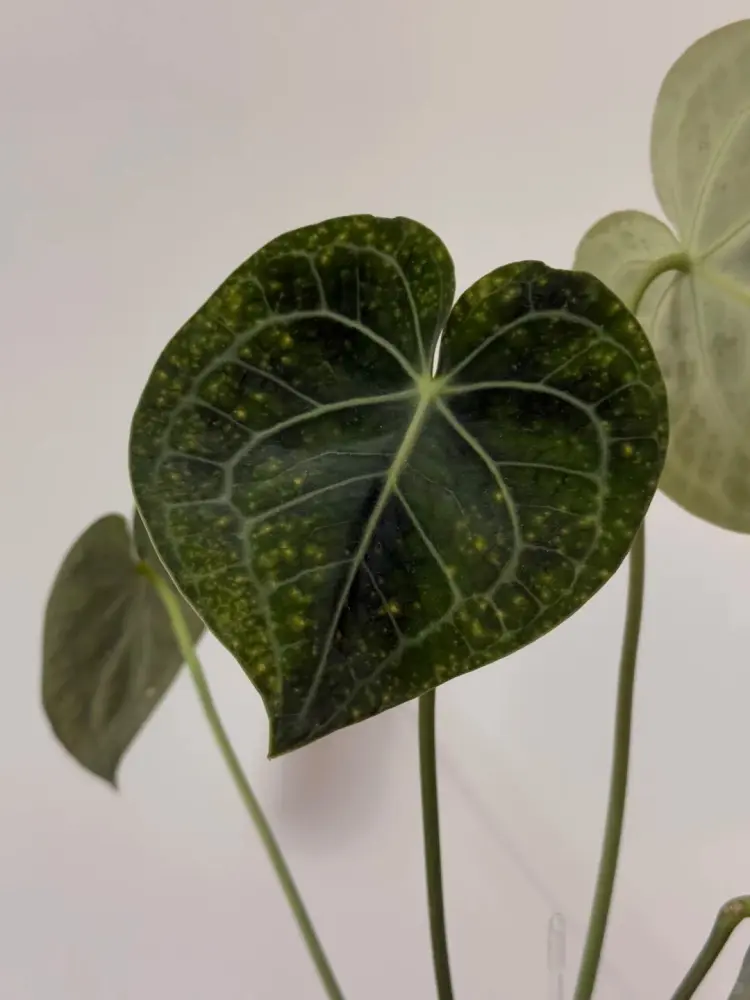
I ended up posting about it on a forum, and someone pointed out that the plant had likely reacted to heat. Around that time, the weather had been much hotter, the light was stronger, and the air felt more stifling than usual. I moved the plant to a cooler, shadier spot, and after that, the yellow spotting stopped getting worse.
That experience changed the way I look at this kind of fine, pale spotting. Not every yellow-speckled leaf means disease. If the spots are tiny, light-colored, and seem to appear after a stretch of heat, harsh light, or stuffy air, I now think about environmental stress first. What mattered most in that case was not spraying something immediately. It was changing the conditions first — and once I did, the damage stopped progressing.
Yellow Spots With Brown Centers That Turned Out to Be a Root Problem
I had another Anthurium that had been sitting in my home for almost a year without producing a new leaf. Then I started noticing yellow spots across several leaves, and over time the centers of those spots began turning brown. At that point, I knew I could not keep looking only at the foliage and hoping the answer was on the surface.
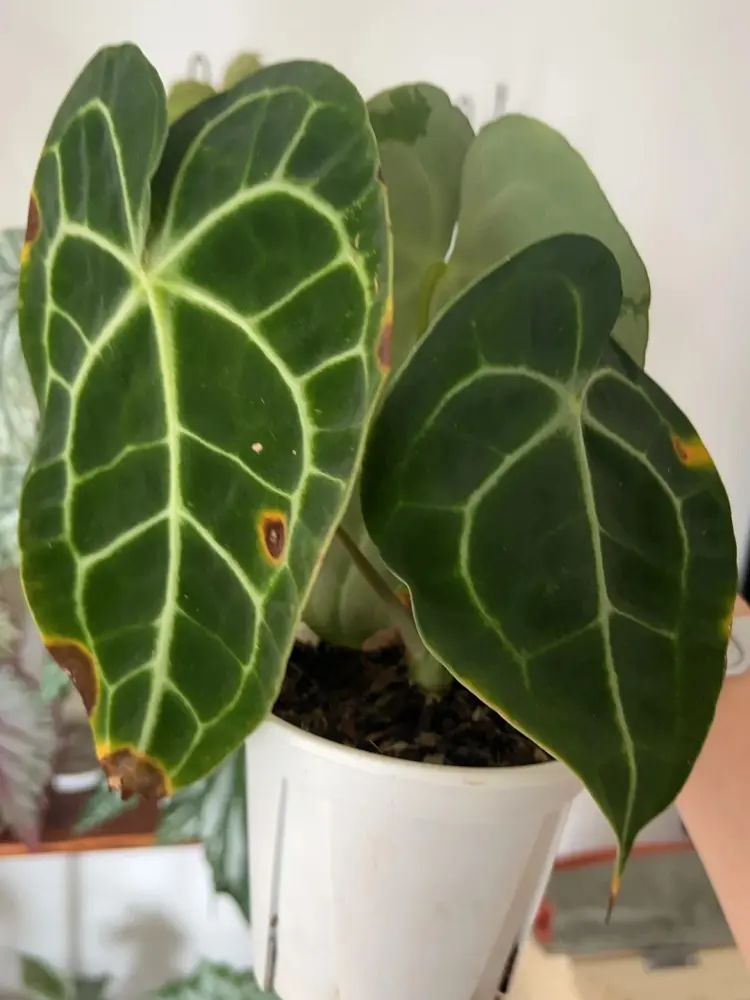
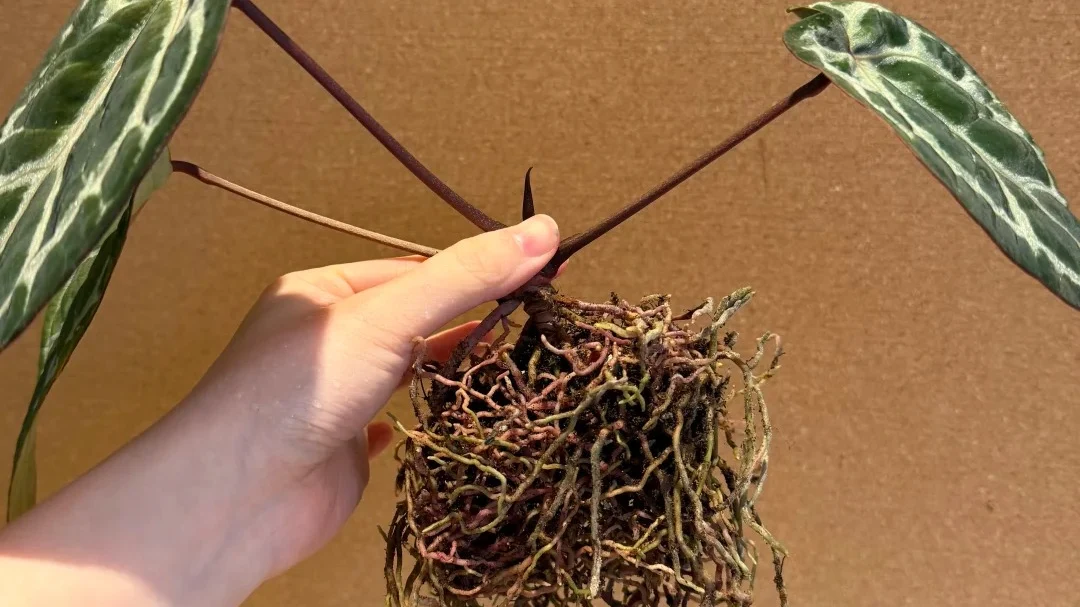
When I checked the roots, they were clearly no longer in good shape. I ended up trimming away the unhealthy parts, repotting the plant into fresh mix, and starting over with the root zone instead of trying to “treat the spots” themselves.
That case taught me something I still come back to all the time: spots on leaves are not always leaf problems. If spotting shows up on a plant that has already stopped growing well, looks low on energy, and has been stalled for a long time, I start wondering whether the real issue is below the soil. In situations like that, the leaf may just be showing the result of a root system that has already been struggling for a while.
Dark Brown Blotches After Extreme Heat Made Me Start Thinking About Infection
During a stretch of weather that went above 40°C, I came back from a trip and found one of my Anthuriums with multiple dark brown blotches on the leaves. These did not look like the fine yellow speckling from heat stress. They were darker, heavier, and more lesion-like, and they immediately felt more serious.
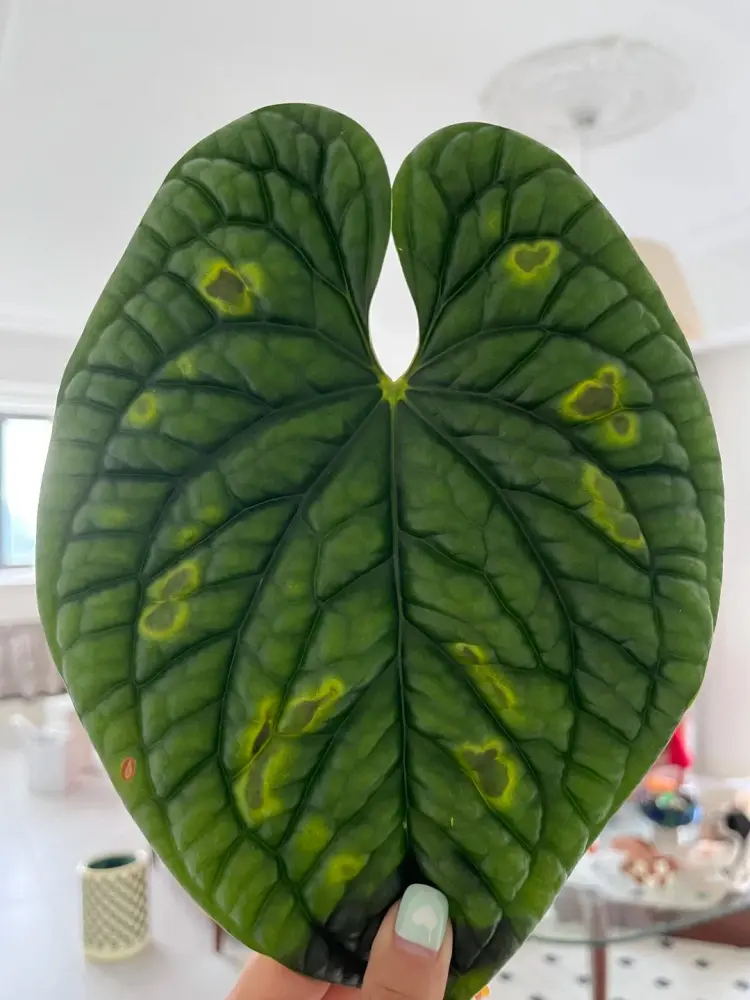
I looked through other growers’ cases and started suspecting fungal infection. In the end, I removed the more seriously affected leaves and sprayed both the plant and the surface of the potting mix.
What stayed with me from that experience was not just the treatment, but the shift in how I was reading the leaf. This was the point where I stopped thinking in terms of simple stress and started considering infection. The spots were deeper in color, more blotchy than speckled, and they appeared after a period of extreme heat that may have weakened the plant enough to make infection more plausible.
That does not mean every dark brown patch after hot weather is fungal. But it was the moment I learned that once the spotting starts looking darker, more sunken, or more like actual lesions than surface stress, I need to widen my thinking beyond light and humidity alone.
A Few Days of Stale, Boxed-Up Humidity Led Me to Anthracnose
Another time, I kept an Anthurium boxed up in a humid setup for a few days. After I took it out and grew it normally again, the leaves started developing spots that looked much more disease-like than simple stress damage. I was especially worried because even the edges of a newer leaf seemed to be showing early signs, which made me start thinking about spread rather than isolated damage.
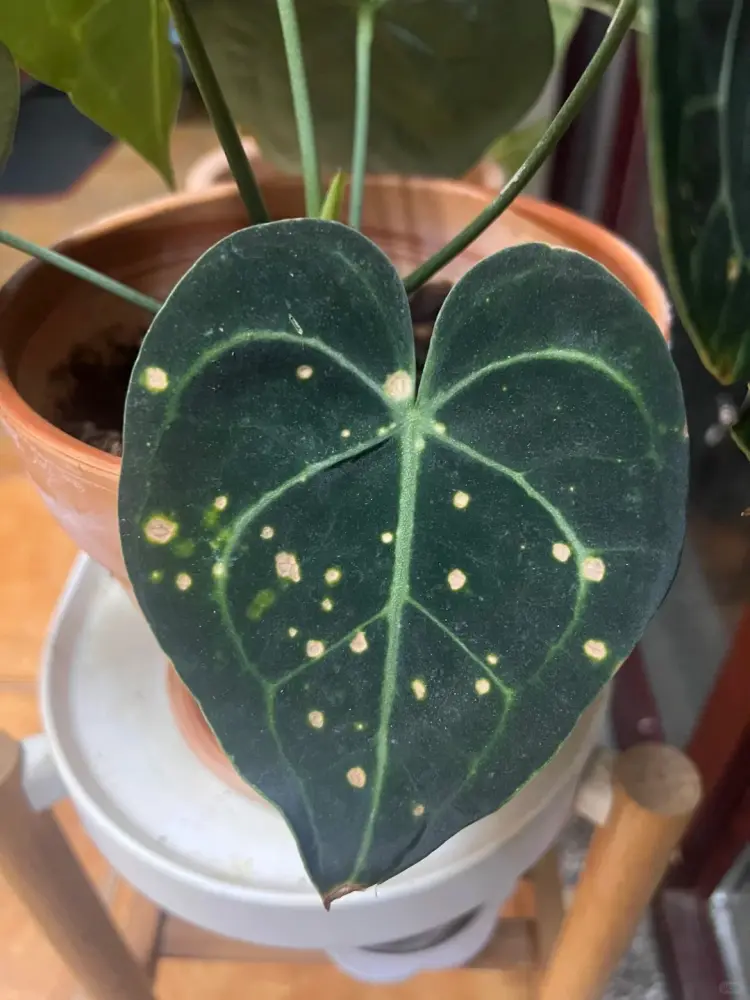
After reading through similar cases, I came to the conclusion that it was anthracnose. I removed the affected tissue and treated the plant rather than just waiting to see what happened.
What made this case feel different from the earlier heat-speckling case was the pattern of progression. It did not feel static. It felt like something that could continue moving through the plant if the conditions stayed favorable. And that was a good reminder that high humidity is not automatically helpful if the air is stale. In a home setup, trapped humidity with poor airflow can create a very different problem from open, breathable humidity around an actively growing plant.
What I Actually Do When I Notice Yellow or Brown Spots
Yellow or brown spots used to make me want to react immediately. I would stare at the leaf, assume the worst, and think about sprays before I had even worked out what kind of problem I was looking at. Over time, I became much more careful about the order I go in, and that has made these situations much easier to handle.
I Change the Environment First if the Plant Still Looks Stable
If the plant still looks reasonably strong overall, I usually start with the environment before I do anything more aggressive. That means moving it out of harsher light, giving it a cooler or more stable spot, and paying attention to whether the air has become too hot, dry, or stagnant.
This matters most when the spotting looks light, shallow, and more stress-related than infectious. In that kind of situation, I would rather adjust the setup and watch what happens next than rush into treatment too early. If the spots stop spreading after the plant is moved into better conditions, that usually tells me I was dealing more with environmental stress than with an active disease problem.
I Check the Roots If the Plant Has Been Sitting Still for Too Long
If an Anthurium has not pushed a new leaf in a long time and the overall plant already looks tired, I do not treat the spots as the main problem right away. In that situation, I usually go straight to the roots and the potting mix, because a weak root system can show up on the leaves in ways that are easy to misread.
If the roots look unhealthy, I trim away the damaged parts and repot into something fresher and airier. For me, that kind of case is less about “curing the spots” and more about getting the root zone back into a condition where the plant can actually grow again.
I Move Faster Once the Spots Start Looking Infectious or Keep Spreading
If the spotting is darker, more lesion-like, or continuing to expand, I become much less relaxed about it. The same is true if newer growth starts showing signs too, or if the problem appeared after a period of stale humidity, boxed-up conditions, or prolonged leaf wetness.
That is usually the point where I stop relying on environmental adjustments alone. I start thinking about removing the more seriously affected leaves and treating the plant more directly. I am still careful not to overreact, but once the pattern starts looking active rather than static, I do not like to wait too long.
I Do Not Treat Every Spotted Leaf the Same Way
This is probably the biggest change in my thinking over time. I no longer see a spotted leaf and assume there must be one standard response. A leaf marked by heat stress is not the same as a leaf reacting to root decline, and neither of those should be handled the same way as spreading, fungal-looking lesions.
If the marks are environmental, changing the setup may be enough. If the real issue is in the roots, spraying the leaves will not solve much. And if the lesions look infectious, simply moving the plant to a different spot may not be enough on its own.
What matters most to me now is figuring out which direction the problem is pointing in before I decide what to do. Once that part becomes clearer, the next step usually becomes clearer too.
What These Spot Cases Taught Me
What these spotted leaves taught me, more than anything else, is that I cannot read them by color alone. Tiny yellow speckles that show up after a hot stretch do not behave like something infectious. Yellow spots with brown centers on a plant that has already stalled push my attention toward the roots. Darker brown blotches that appear after extreme heat can be a sign that I need to think beyond simple stress. And spotting that shows up after days of boxed-up humidity makes me think much more seriously about fungal spread and airflow.
Over time, I have stopped asking broad questions like, “What causes brown or yellow spots on Anthuriums?” In real life, that question is often too vague to help much. What helps more is narrowing it down: What do the spots actually look like? Are they staying dry and contained, or getting darker and more active? Is the plant still growing, or has it already been stalled for months? Did something in the environment change right before the spots appeared?
That shift has made a big difference for me. I do not need every spotted leaf to fit into one neat category anymore. I just need to read the pattern well enough to know which direction to investigate first.
In the end, the color matters less than the pattern, the speed, and what the whole plant is doing.
FAQ
Still unsure what your Anthurium is trying to tell you?
A single leaf symptom can be misleading on its own. If your Anthurium is struggling with yellow leaves, brown spots, drooping, slow growth, or root issues, you can browse the full problems hub for the patterns I watch and the adjustments that have helped most in my home.
Go to Problems Hub →